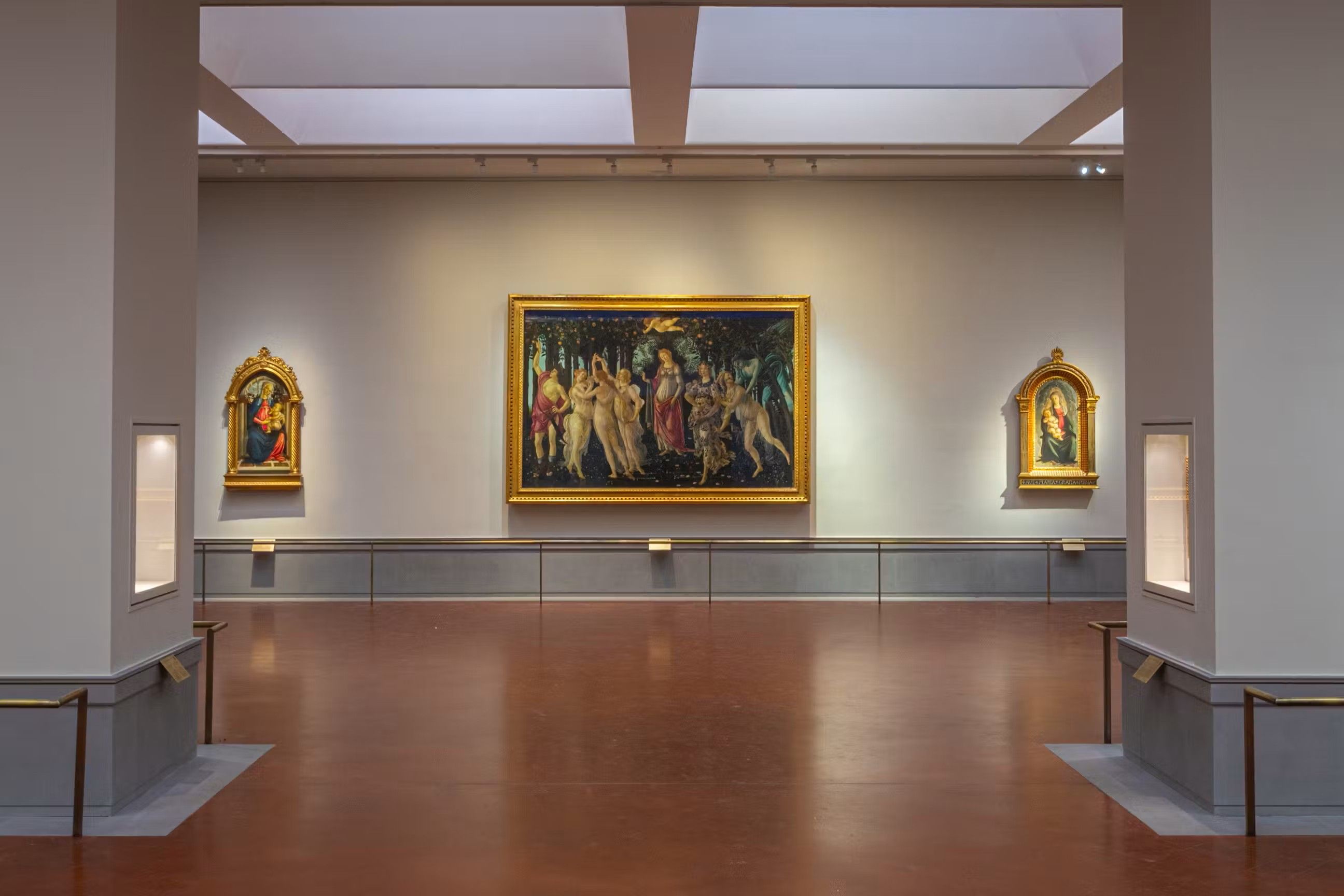
At the Uffizi Gallery the new permanent installation of the Botticelli Rooms
Wed, 06/17/2026 - 13:29
At the Uffizi Gallery the spaces dedicated to the masterpieces of the Renaissance master have been completely renovated.
The most celebrated deities painted by the great Renaissance master Sandro Botticelli, Venus and Spring (Primavera), are now displayed facing one another.
The new permanent installation of the spaces dedicated to the Florentine genius of fifteenth-century painting places them in an unprecedented and direct dialogue. And, for the first time, they are placed in airtight display cases that ensure the works’ preservation under the highest conservation and security standards, eliminating the large external protective glass windows that altered the direct perception of the monumental paintings hanging on the walls.
Flanking the Venus are now Botticelli’s tondi of the Madonna of the Magnificat and the Madonna of the Pomegranate. In a corresponding and symmetrical arrangement, the room facing this one now presents the Primavera flanked by two complementary Marian images: the Madonna of the Rose Garden and the Madonna of the Cherubim. Through the striking similarity between the faces of the Virgin and the goddess, these three works evoke the doctrine of the prisca theologia developed by Marsilio Ficino within the Neoplatonic Academy fostered by the Medici. This concept, which underpins much of Botticelli’s artistic vision, held that the ancient world had already anticipated the divine truths of Christianity and that many pagan deities could be understood as prefigurations of Christian figures. In the case of this learned juxtaposition proposed by the Uffizi, the reference is specifically to Venus and Mary, the Mother of Christ.
Botticelli's artistic and intellectual journey is presented in this room with particular historical-critical care. The opening work is the Adoration of the Magi from the Gaspare di Zanobi del Lama Chapel, a true family portrait of Medici power, highlighting the artist's self-portrait at the center of fifteenth-century society. The sequence closes with The Calumny of Apelles (1495), a work from the tumultuous years of Savonarola's Florence and the profound religious and spiritual crisis experienced by Botticelli.
Significant changes have also been introduced in the room dedicated to Piero and Antonio del Pollaiolo, contemporaries of the young Sandro Botticelli. An entire wall has been redesigned to accommodate and highlight the celebrated Virtues, reinstalled in their nineteenth-century gilded frames, with particular emphasis on Fortitude, Botticelli’s first documented work (1470), commissioned by Tommaso Soderini, perhaps with the intention of diverting this prestigious commission from Piero del Pollaiolo.
A new installation has been conceived also for the large, detached fresco of the Annunciation, allowing it to appear once again as an integral part of a wall, exactly as it originally did in Florence’s Church of San Martino.
The cultural and artistic atmosphere of Florence during Botticelli’s time is further evoked through the presence of the Cardinal of Portugal Altarpiece by the Pollaiolo brothers, the Cafaggiolo Altarpiece by Alesso Baldovinetti - who collaborated with the Pollaiolo in the chapel of San Miniato al Monte where the Cardinal’s Altarpiece was executed.
The colour selected for these newly renovated galleries is a very light “Renaissance grey,” which, together with the new lighting system, enhances the softness and delicate chromatic nuances of Botticelli’s art.
For the first time, in-depth information is provided by digital mediation devices through videos present in the room and accessible directly on smartphones via QR codes, as well as for the description of the artworks, which can also be linked via QR codes integrated into the gallery labels.
Watch the video!
Visit the new rooms with Firenzecard!
Photo credits © Uffizi Gallery